

Be the founder investors take seriously.
Walk into your raise with numbers you understand and a plan you can explain. An investor-ready financial model, built with you in 1–2 weeks.
For founders a year or more in, with real traction and early money from friends and family, angels or grants, now raising the next round.

The one-page investor summary every model ships with: runway per scenario, key assumptions, what changed and the decisions needed. Lumen Software BV is a fictional sample company.
Models investors have already backed
A $4.5M equity round
The financial model behind a closed equity round for a multi-entity equipment-as-a-service group.
UK seed rounds
Seed-round models for UK agritech and energy-tech companies, used in live investor meetings and data rooms.
About $50M raised
In-house, the models behind about $50M raised, after two years on the investor side deciding which businesses got funded.
The raise date is set, and the model isn't ready for it
The date is close
Investors meet in weeks, and the model still needs work you don't have time for.
"When can we see the model?"It doesn't balance or tie out
It was built by someone who left, or the P&L, balance sheet and cash don't tie.
"Why doesn't the balance sheet balance?"There's no real downside case
Runway is one number. Nobody has modelled slower growth, or the round closing late.
"What if the round closes six months late?"Revenue is a growth rate
Growth isn't built from customers, pipeline, pricing and churn, so it can't be defended.
"What drove last year's growth?"Deck, model and KPIs disagree
ARR on the traction slide isn't the number in the model or the accounts.
"Which number is right?"Diligence questions with no answer
Investors ask for cohorts, CAC payback and burn multiple, and the model can't produce them.
"Can you send retention by cohort?"
A model investors can test, and your team can run
Built from your drivers, with every check reading zero, and handed over so your team can use it without us.
Driver Map
What drives revenue and costs, agreed and signed off with you before anything is built.
Integrated 3-statement model
P&L, balance sheet and cash flow on one monthly timeline, laid out to the FAST Standard, with a Balance Check Panel where every check must read zero.
Scenarios and stress tests
Base, downside and upside, plus tests such as the round closing 3 or 6 months late, or losing your biggest customer.
Runway and use of funds
The cash-out date per scenario, the latest safe month to close, and what the round buys on the way to your next milestone.
Assumptions Book
Every assumption with its source and owner, so you can defend it in the room.
Investor summary
One page: runway per scenario, key assumptions, what changed and the decisions needed.
Handover
A walkthrough, a recording and a maintenance guide. The file is yours.
Fundraise Readiness Pack
Diligence Q&A answered from the model, KPI history and the financial folders of your data room.
Model Review
A written opinion (fit, fit with fixes, or rebuild), an error log and a fix list. We check structure against the FAST Standard and run our integrity checks. A review, not an audit.
Model Build
The Investor-Ready Financial Model, built with you in 1–2 weeks.
Fundraise Readiness Pack
Diligence Q&A, KPI history and data-room financial folders, alongside the build.
Model Care
Monthly actuals, assumption updates and scenario requests, so the model stays current after the raise.
From your current model to investor-ready in 1–2 weeks
Your time: two working sessions, plus kickoff and handover. The delivery date is agreed in writing at kickoff.
- Day 1
Review or kickoff
We review the model you have, or start fresh. The delivery date is agreed in writing.
- Week 1
Drivers
Session 1: we map your drivers with you. You sign them off before we build.
- Weeks 1–2
Build
Integrated statements, scenarios, stress tests and the Runway View.
- End of week 2
Handover
Session 2, revisions, then a walkthrough and recording. The file is yours.
How we build and check every model
Built to the FAST Standard
We structure every model using the FAST Standard, a free, published modelling standard (Flexible, Appropriate, Structured, Transparent) maintained by the FAST Standard Organisation. In practice:
- inputs sit apart from calculations
- each number is calculated once
- formulas stay consistent across every month
- no numbers are typed inside formulas
- there are no circular references
Where a model has to break a rule, we list the exception in the model's notes.
Six tests before handover
Written into the scope, so "done" means the same thing to both of us.
- The balance sheet balances in every month, including the last.
- Opening cash ties to the bank statement.
- History ties to your accounts.
- The scenario switch drives every schedule.
- No numbers are typed inside formulas.
- You change a driver yourself and see runway update.
What you receive
Both samples use Lumen Software BV, a fictional company, so you can see the real format without anyone's confidential numbers.
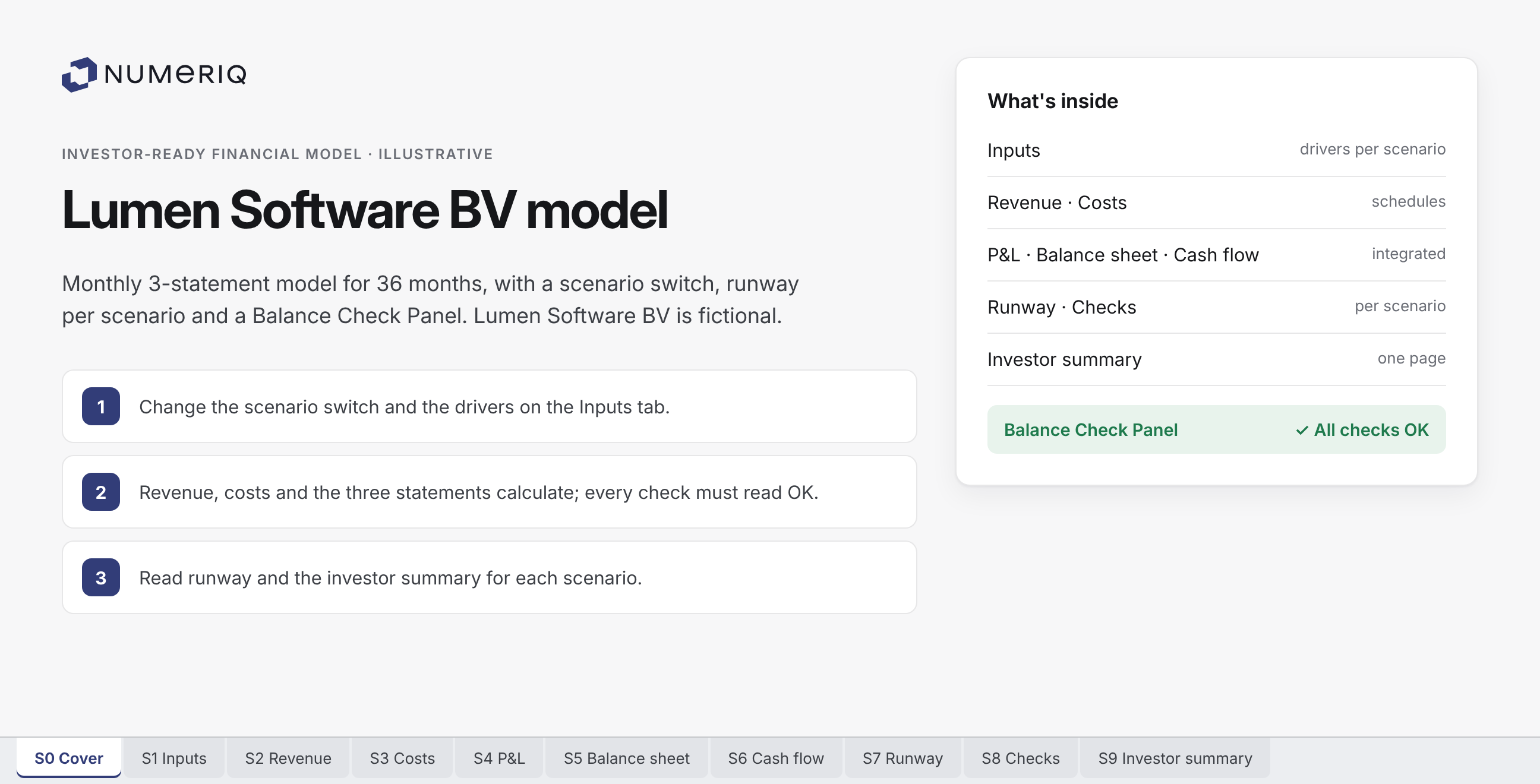
Sample model and investor summary
The model opens on a cover tab with runway per scenario. Its one-page investor summary is what investors read first.
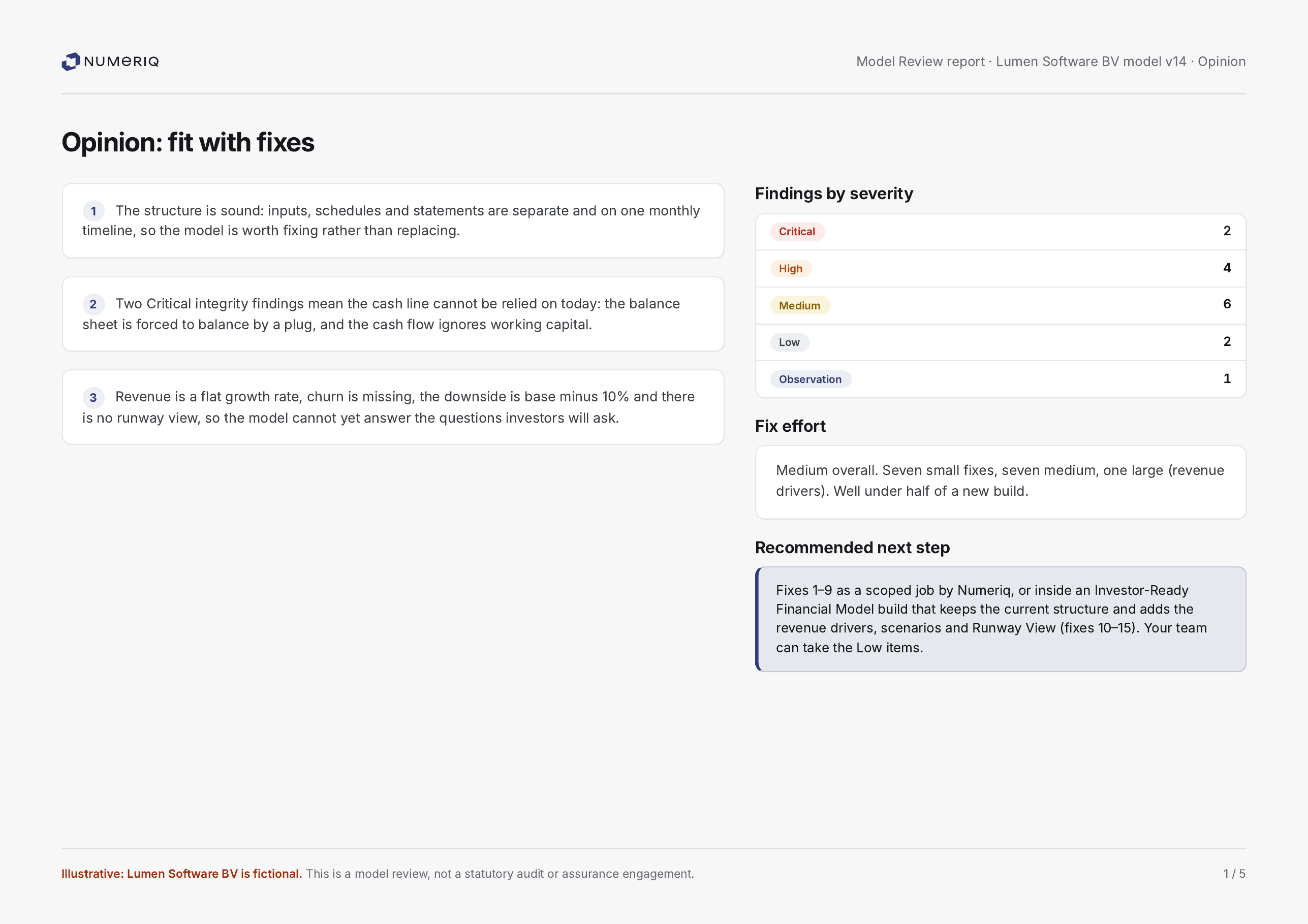
Sample Model Review report
What the Model Review delivers: an opinion, findings by severity, the effort to fix, and the recommended next step.
Check your own model before investors do
Five tools you can use on your own, with no sign-up and no call. Each one runs in your own copy, so your numbers stay with you.
- PDF12 checks before you send your modelAn hour's checklist. Does your model balance, show what drives growth, and show the downside?2 pages ↓
- PDFThe investor question bank30 questions investors ask about your model, and where a good answer points.6 pages ↓
- XLSXRunway stress testSix numbers in, and see your cash if the round closes on time, 3 or 6 months late.Excel ↓
- XLSXRaise timing calculatorThe latest safe month to close, and the dates to work back from: model accepted, data room ready, first meetings.Excel ↓
- XLSXARR bridge templateNew, expansion, contraction and churn by month, with a check that your deck's ARR matches.Excel ↓
✓Want a second pair of eyes on what you find? Book a 20-minute call.
If you're raising in the first half of 2027, start the build by January
Your model should be accepted about four weeks before your first investor meetings. Work back from the meetings, and the build starts sooner than most founders expect.
- Early JanuaryModel build starts
- Mid JanuaryModel accepted, data room filling
- FebruaryFirst investor meetings
Meet Ismael Dubale, founder

Investor side first, then company side
Founder, Numeriq · Rotterdam
- Roha GroupTwo years at a company builder, building the models and investment cases that decided which new businesses got funded.
- AAFCHead of Finance at an international multi-entity group. Built the models used for fundraising and supported capital raising end to end: investor discussions, term sheets, covenants and due diligence.
- EarlierBusiness control at Heineken and commercial planning at Ethiopian Airlines.
- EducationEconomics degree and an MBA from the University of Manchester.
A good fit if
- You've been trading for a year or more, with real traction
- You've already raised from friends and family, angels or grants
- You're raising your next round, and the numbers have to carry the story
Not what we do
- Pitch-deck design
- Legal, tax or valuation opinions
- Bookkeeping, month-end close or monthly management packs
Before you book
Will this get us funded?
No one can promise that. We prepare a model investors can test, one that answers the questions they ask in diligence. Whether you raise depends on your business, the market and your investors.
Is the Model Review an audit?
No. It's a review of your model's structure, integrity and logic, with an opinion and a fix list. It isn't a statutory audit or an assurance engagement.
Are your models FAST-certified?
No. FAST is a public standard that anyone can apply. We follow it when we build and use it as a reference when we review. We don't have FAST certification, and we don't certify models as FAST-compliant.
How much of our time does it take?
Two working sessions with you, plus a kickoff and a handover. Session 1 maps and signs off your drivers; session 2 reviews the built model. We do the rest.
What do you need from us?
Your current model, if you have one; your accounts and opening cash; pipeline, pricing and customer data; and the date of your first investor meetings. You get one short data request at kickoff.
What if the round takes longer than planned?
Every model includes stress tests for the round closing 3 or 6 months late, with the lowest cash point and the costs you would stop, so you can answer the question before an investor asks it.
Do we own the model?
Yes. You get the file, a recorded walkthrough and a maintenance guide. Nothing is locked to us.
Do you build the pitch deck?
No. We make sure the numbers in your deck tie to the model and your KPI history. The deck's design stays with you.
Can you keep the model up to date after the raise?
Yes, through Model Care: monthly actuals, assumption updates and scenario requests, so the model stays the one your investors rely on.
Is the Model Review really free?
Yes. If you have a model, we review it and tell you whether it will hold up: fit, fit with fixes, or rebuild, with a short fix list. No obligation to build with us.
What if an investor asks something the model can't answer?
For 30 days after handover, we update the model within 2 working days, free. The only conditions: you join both working sessions and send the data on our request sheet.
How is it priced?
Every step has a fixed fee, agreed in writing before we start. We'll confirm the fee for your situation on the 20-minute call.
Tell us what's coming up. We'll tell you what the model needs.
A 20-minute call. No preparation needed.
- Tell us briefly what's coming up.
- Choose a time in the calendar.
- We confirm by email. If you have a model, bring it, and we can look at it together on the call.
Rather skip the form? Pick a time directly. Prefer email? ismael@numeriqco.com